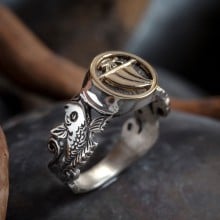
Musashi Samurai Water Ring Silver and Gold
Musashi Samurai Water Ring — Book of Five Rings Inspired Jewelry
Musashi Water Ring inspired by The Book of Five Rings — a symbol of flow, adaptability, and calm precision. Inner strength that moves without breaking.
Miyamoto Musashi — Philosophy as a Way of Life
Miyamoto Musashi (1584–1645) was not only one of Japan’s most legendary swordsmen, but also a philosopher of discipline, clarity, and inner strength. His life was shaped by combat, solitude, and relentless self-mastery — a path that led him beyond victory into understanding.
In his final years, Musashi wrote The Book of Five Rings (Go Rin No Sho), a timeless guide to strategy, mindset, and human nature. But this work is far more than a martial text. It is a philosophy of living with precision: eliminating distraction, cultivating presence, and building a mind that cannot be shaken.
Musashi’s teachings revolve around five elemental principles — Earth, Water, Fire, Wind, and Void — each representing a different dimension of strategy and consciousness. Together, they form a complete system: grounded, adaptive, fierce, observant, and ultimately free.
This ring series is built on that structure — not as decoration, but as a wearable philosophy. A quiet reminder of the Inner Axis: the center within you that remains steady, even when everything around you shifts.
In The Book of Five Rings, Water represents adaptability: the ability to change form without losing essence. Water is never fixed — it becomes what the moment requires. It flows around obstacles, finds the path of least resistance, and yet over time it shapes stone.
For Musashi, Water is the mindset of strategic flexibility. Not softness — but intelligence. It is the discipline of staying calm while adjusting, reading the situation clearly, and responding without hesitation.
The Water Ring embodies this principle as a wearable reminder of controlled movement and inner clarity. It speaks to those who understand that strength is not always force — sometimes it is timing, awareness, and the ability to shift without breaking.
To wear the Water Ring is to choose:
* adaptability without losing direction
* calm presence under pressure
* precision in movement and decision
* flow as a form of power
It is for the person who remains centered — even while changing.