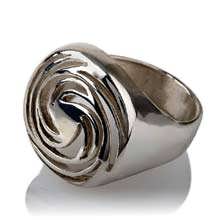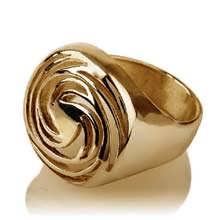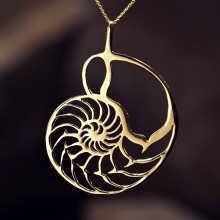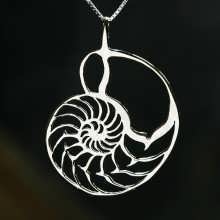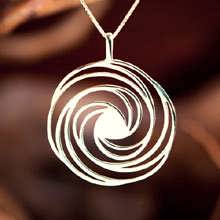
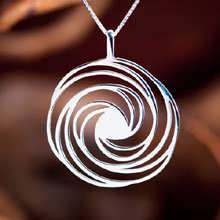
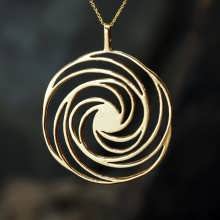
Golden Spiral
Symbol of Harmony
and beauty
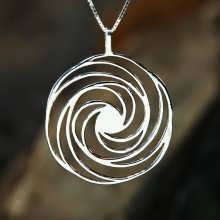
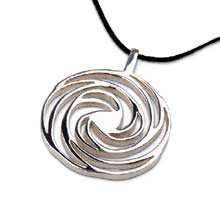
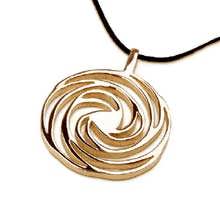
Golden Spiral shape
The
Golden Spiral structure
represents two well known sacred geometry shapes: the
golden mean (phi) spiral and the
Fibonacci spiral. It is a based on a
crop circle shape known as the "Hackpen Hill Formation" and it appeared
in an English wheat field in 1999.
Phi (golden mean) - "The key to the physics of the cosmos" (plato)
Phi is a constant value which is even more
mysterious and
profound in its implications than pi. Like pi, phi is a number
with no arithmetical solution. The decimals just keep on going into
infinity without ever repeating themselves. The unique thing about this
number is that it can be found incorporated in all known organic
structures. From the bone structure of human beings to the seed pattern
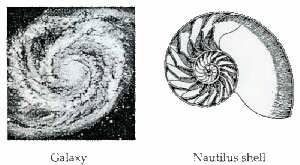
of a sunflower to the spiral of a sea shell, the phi proportion is
there, underlying all biological structures, seeming to be a
geometrical
blueprint for life itself.
Plato went so far as to call
the phi ratio the "
key
to the physics of the cosmos". Phi is calculated at
1.6180339+..., and while it cannot be worked out arithmetically, it can
be easily obtained with a compass and straightedge.
Join David's customer club
Get updates on new designs and special sales.
Members Benefit:
Stay updated with David's new designs.
Get periodic discount and coupons.
Learn how David's work benefits others.
Win 14k Merkaba prana pendantLottery will take place on April 1st
Finding the golden mean
Two simple ways of finding the Golden Section geometrically are as
follows:
Method one
If you take two equal squares, side by side, (a 1x2 rectangle), divide
one of the squares in half, and with a compass, swing the diagonal down
to the base of the other square, the point where the diagonal touches
the base will be phi, or 1.6180339+, in relation to the side of the
square, which is 1 (This formula also describes exactly the rectangular
floor of the King's Chamber).
Method two
The other method of determining the Golden Section is by dividing a
line segment, AB, at a point C, in such a way that the whole line is
longer than the first part in the same proportion as the first part
being longer than the remainder. AB/AC = AC/CB = 1.6180339 (notice the
fractal and holographic nature of this ratio...).
Whoever
cultivates the golden mean,
avoids both
the poverty of a hovel and the envy of a palace.
(Ancient Roman poet)
Golden mean in architecture
The
phi ratio is found in the
architecture of the
Great Pyramid
in the triangle formed by the height, half-base, and the apothem, or
diagonal. In other words, the basic cross - section of the structure
demonstrates the
Golden Section.
If the half - base is given a value of 1, this gives the value of phi
for the apothem, and the square root of phi for the height. The Golden
Section shows up again and again in
Giza
and in much more baffling and tedious ways (Entire volumes have been
written on the geometries involved in the pyramids construction).
Fibonacci sequence and the golden spiral
| There is a number sequence,
known as the Fibonacci sequence,
which bears a special relationship to phi, and to the pyramids at Giza.
First postulated by the medieval mathematician Leonardo Fibonacci,
this sequence was used to describe the growth patterns of plants. It
goes: 1,1,2,3,5,8,13,21,34,55,89,144,233, etc. It is made by adding the
last two numbers of the sequence to get the next one, as in: 1+1=2,
1+2=3, 2+3=5, 3+5=8, 5+8=13, etc. |
|
This sequence's relationship to phi is that if you divide one term of
the sequence into the next one, the result begins to quickly approach
the transcendental number 1.6180339+... (I won't make you do the math.
Just watch...)
1/1=1 2\1=2 3\2=1.5 5\3=1.66 13/8=1.625
21/13=1.615 34\21=1.619 55\34=1.617 89\55=1.6181
The further you go down the sequence, the closer you get to phi. Of
course, you can never actually get to it exactly, since it has no
mathematical solution, it just keeps getting closer and closer, to
infinity.
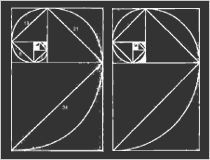
The sequence can be graphed out in the form of a spiral, called the
Fibonacci Spiral. This spiral is
almost identical to the graph of the logarithmic spiral of the phi
ratio, known as the Golden Mean Spiral (The difference is that the
Fibonacci spiral is a whole number interpretation of the arithmetically
impossible Golden Mean spiral, which has no beginning or end. The
Fibonacci spiral has a definite beginning).
Fibonacci spiral and the pyramids of Giza
Aerial photographs show that the pyramids at Giza are positioned in
such a way that they fall on a line which accurately defines a
Fibonacci spiral. The spiral passes exactly through the centers of each
pyramid.